If you have ever tripped over a downspout extension in your yard, watched one get knocked out of position by the lawn mower, or simply wished that the water coming off your roof would disappear into the ground instead of running across your landscaping, a pop up emitter may be exactly what you need. These simple devices sit flush with the ground when not in use and open automatically when water pressure builds in the underground pipe, allowing water to discharge away from the house and then closing again when the flow stops.
Pop up emitters are one of the most popular drainage solutions in the Portland metro area because they solve a common problem elegantly. They move water far from the foundation, stay out of the way of foot traffic and yard maintenance, and require very little ongoing attention. Understanding how they work, how they are installed, and what maintenance they need helps you decide whether they are the right choice for your property.
How Pop Up Emitters Work
A pop up emitter is a round cap, typically three to six inches in diameter, that sits at ground level at the end of an underground drainpipe. The cap is attached to a spring loaded mechanism inside a housing that connects to the buried pipe. When rain flows through the gutters, down the downspouts, and into the underground piping, the water pressure builds at the emitter end. Once enough pressure accumulates, the cap lifts open and water flows out across the ground surface away from the house. When the rain stops and the pipe drains, the spring pulls the cap back down to a closed position, sitting flush with the lawn.
The closed position serves two important purposes. First, it keeps debris, dirt, insects, and small animals from entering the drainage pipe and causing clogs. Second, it creates a clean appearance in the yard with nothing protruding above the grass line. From a distance, a pop up emitter is nearly invisible, which makes it far more attractive than a corrugated black pipe running across the yard or a concrete splash block sitting at the base of every downspout.
Most pop up emitters are designed to handle the flow from a single downspout, though some larger models can handle two downspouts connected to a shared underground line. The emitter should be sized to match the capacity of the pipe feeding it. A standard 4 inch underground pipe paired with a matching 4 inch emitter handles the output from a typical residential downspout without difficulty, even during heavy Oregon rainfall.
Installation Basics
Installing a pop up emitter involves connecting the downspout to an underground pipe, trenching across the yard to a discharge location, and setting the emitter in the ground at the end of the run. The process is straightforward but the details matter for long term performance.
The underground pipe needs a consistent downward slope from the downspout connection to the emitter. A minimum slope of one eighth inch per foot is recommended, though a quarter inch per foot is better for ensuring that water flows freely and sediment does not settle in the pipe. The pipe should be buried at least six to eight inches deep to avoid damage from foot traffic, lawn equipment, and shallow digging.
The discharge point where the emitter sits should be at least six to ten feet from the foundation. Farther is better whenever the yard allows it. The goal is to move water well beyond the zone where it could migrate back toward the house through the soil. In Portland area yards where lot sizes vary widely, the optimal placement depends on the property layout, the slope of the yard, and the locations of landscaping beds, walkways, and property lines.
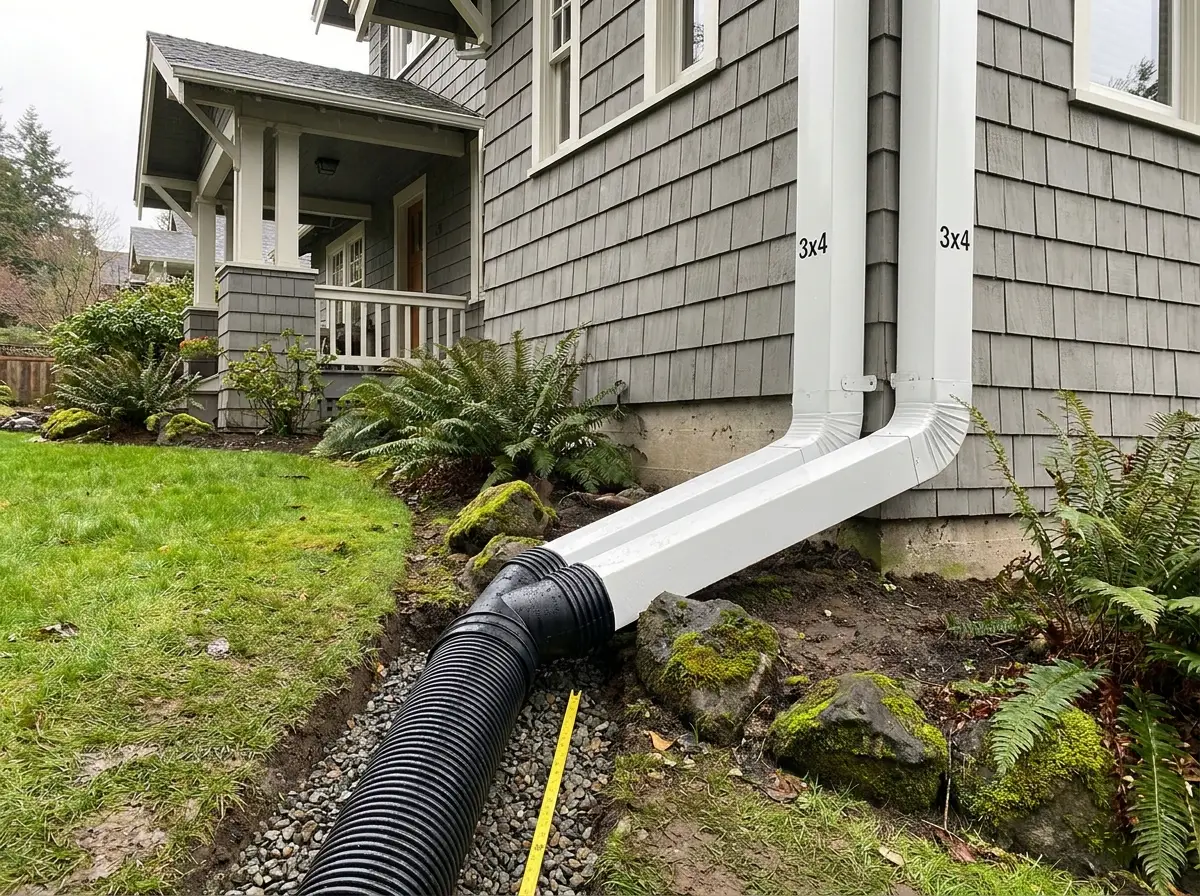
At the downspout connection, a transition fitting adapts the rectangular downspout to the round underground pipe. This fitting should be secured with screws and sealed with silicone to prevent leaks at the junction. Some installers use a catch basin at this transition point, which provides an access point for flushing the line and catching debris before it enters the underground pipe. A catch basin adds a small amount of cost but makes future maintenance much easier.
The trench should be dug wide enough to work comfortably and deep enough to bury the pipe with several inches of soil cover above it. Once the pipe is laid and the connections are made, backfill the trench and compact the soil lightly. The emitter housing is set so that the cap sits exactly at ground level, not above the grass where it will get hit by mowers and not below grade where soil and mulch will cover it.
Maintenance and Freezing Concerns
Pop up emitters require minimal maintenance, but they are not completely maintenance free. The most common issue is debris accumulation around or on top of the cap. Grass clippings, leaves, and mulch can settle on the emitter and prevent it from opening fully. A quick check before the rainy season to clear anything sitting on the cap takes only a moment and ensures the system works when the first heavy rain arrives.
The spring mechanism inside the emitter can weaken over time, especially in cheaper models. If the cap does not pop open with normal water pressure or does not close fully after the rain stops, the spring or the entire emitter insert may need replacement. Replacement inserts are inexpensive and can be swapped out in a few minutes without digging up the underground pipe.
Periodically flushing the underground pipe with a garden hose helps prevent sediment buildup. Running water through the system at full hose pressure for a few minutes pushes out any fine material that has settled in the pipe. If you have a catch basin at the downspout transition, check it during the flush and clean out any debris that has collected in the basin.
Freezing is a common concern for Oregon homeowners, though Portland's winters are generally mild enough that underground pipe freezing is rare. The greater risk is during the occasional ice events that hit the area every few years. If the emitter cap freezes shut during an ice storm, water pressure in the pipe has nowhere to go, which can cause the underground connections to separate or the pipe to crack. Some emitters are designed with a relief feature that allows water to escape around the cap edges even when the cap is frozen. For extra protection, choosing a frost resistant emitter and ensuring the pipe has proper slope so water does not stand in the system between rain events reduces the risk significantly.
Pop up emitters work well as part of a complete gutter and drainage system. When combined with properly sized gutters, adequate downspouts, and correctly sloped underground piping, they provide clean, reliable water management that protects your foundation and keeps your yard looking neat. For Portland area homeowners who want their drainage system to be effective and invisible, pop up emitters deliver on both counts.