If you have started researching new gutters for your home, you have probably come across the term seamless gutters. They are the most popular type of residential gutter installed today, and for good reason. But what exactly makes a gutter seamless, and how is it different from the sectional gutters you can buy at a hardware store? In this article, we will explain what seamless gutters are, how they are fabricated on site at your property, and what the installation process looks like from start to finish.
How Seamless Gutters Are Made
The defining feature of a seamless gutter is that each run is formed from a single, continuous piece of metal. Unlike sectional gutters, which are assembled from precut sections joined by connectors, seamless gutters have no joints or seams along the straight runs. The only connections in a seamless system are at the corners, end caps, and downspout outlets.
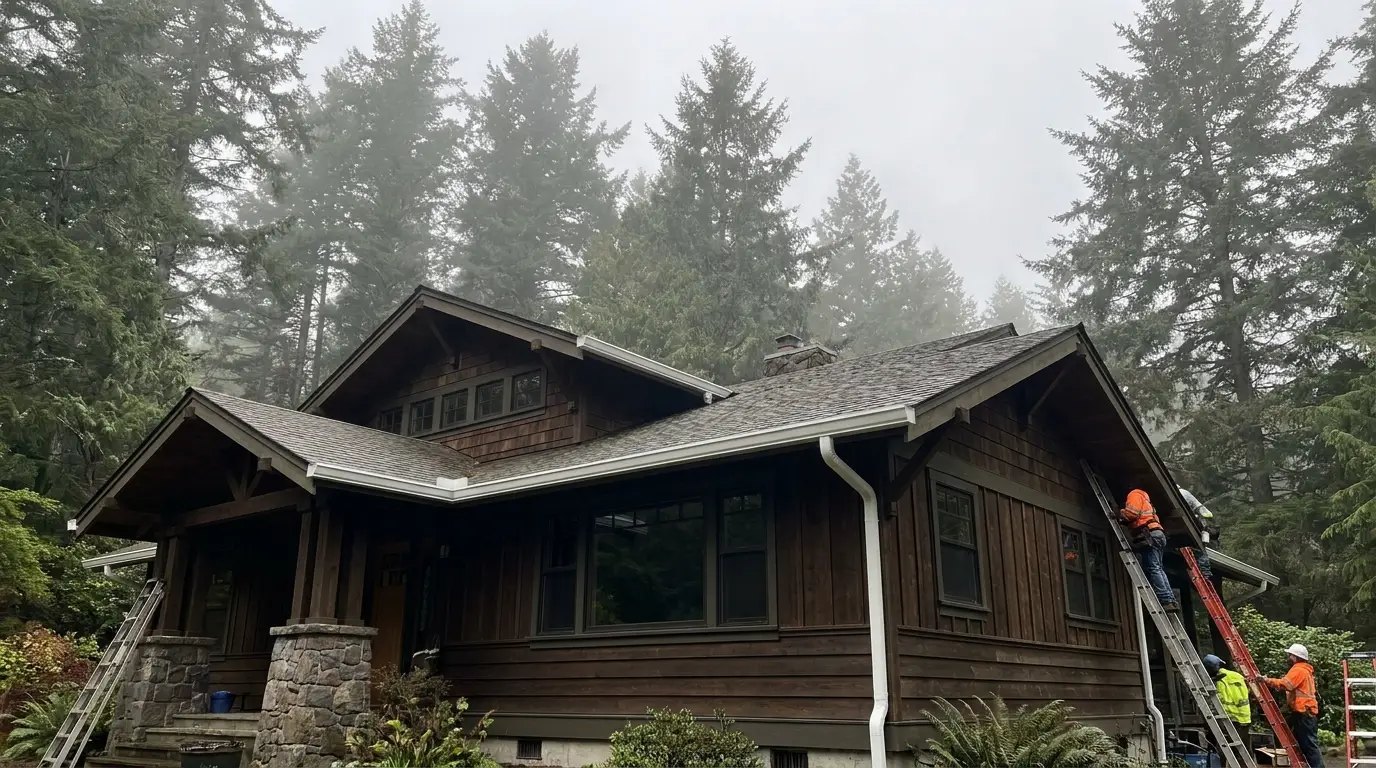
Seamless gutters are not manufactured in a factory and shipped to your home. They are fabricated on site, right in your driveway or on the street in front of your house, using a portable roll forming machine. This machine is typically mounted on a truck or trailer and carried by the installation crew to every job site.
The fabrication process starts with a large coil of flat metal, usually aluminum, that is loaded into the roll forming machine. The coil comes in a specific width and gauge that corresponds to the finished gutter profile. For a standard 5 inch K style gutter, the coil is typically 11.75 inches wide. For a 6 inch gutter, the coil is wider.
The flat metal strip is fed through a series of rollers inside the machine. Each set of rollers bends the metal incrementally, gradually shaping it from a flat strip into the finished gutter profile. The K style profile, which is the most common residential style, has a flat bottom, angled sides, and a decorative front lip that resembles crown molding when viewed from the ground.
As the metal passes through the final set of rollers, it emerges from the machine as a fully formed gutter channel. The technician runs the machine until the gutter reaches the exact length needed for that particular section of the roofline, then cuts it to size. A single run can be 50, 60, or even 100 feet long with no seams or joints along its entire length.
The entire forming process takes only a few minutes per run. The machine operates on a gas motor or connects to the truck's power supply. Watching the process is actually quite interesting. A flat strip of metal enters one end of the machine, and a perfectly shaped gutter channel slides out the other end, ready for installation.
The Installation Process
Once all the gutter runs have been fabricated, the installation crew begins mounting them on the house. The process involves several steps that ensure the gutters perform correctly and last for decades.
First, the crew inspects the fascia boards along the roofline. The fascia is the vertical board that runs along the edge of the roof, and it is what the gutters attach to. If the fascia is rotted, warped, or damaged, it must be repaired or replaced before the gutters can be installed. Installing new gutters on compromised fascia is a waste of money because the gutters will not stay securely mounted.
Next, the crew establishes the proper slope for each gutter run. Gutters are not installed level. They are pitched slightly toward the downspout locations so that water flows by gravity toward the drainage points. The standard slope is approximately a quarter inch of drop for every 10 feet of gutter length. Getting this slope right is critical. Too little slope and water pools in the gutters. Too much slope and the gutters look visibly tilted from the ground.
The gutters are then mounted to the fascia using hidden hangers spaced every 24 to 36 inches along the run. Hidden hangers are clips that sit inside the gutter channel and screw through the back of the gutter into the fascia board. They provide strong support without visible hardware on the outside of the gutter. This is a significant improvement over the old spike and ferrule method, which used large nails driven through the front of the gutter. Spike systems tend to loosen over time and are one of the main reasons older gutters sag and pull away from the house.
After the gutter runs are mounted, the crew installs the end caps, corner pieces, and downspout outlets. End caps are sealed with a durable adhesive sealant to prevent leaks. Corners are formed from separate pieces and riveted and sealed to the gutter runs. The downspout outlets are cut into the gutter channel at the designated drainage points and sealed around the edges.
Finally, the downspouts are installed. Each downspout connects to a gutter outlet and runs vertically down the side of the house to ground level. At the bottom, the downspout terminates with an elbow or extension that directs water away from the foundation. In some cases, downspouts connect to underground drainage pipes that carry water to a storm drain or dry well.
The entire installation process for a typical Portland home takes about half a day for a two person crew. Larger homes or homes with complex rooflines may take a full day. There is minimal disruption to the homeowner, and the work area is cleaned up at the end of the job.
Why Seamless Is the Standard for Oregon Homes
Seamless gutters have become the standard for residential installations in Oregon because they outperform sectional systems in virtually every category. The absence of joints along the straight runs means dramatically fewer leak points. The smooth interior channel moves water more efficiently and is less prone to clogging. The custom fabrication ensures a precise fit for every home, regardless of the roofline complexity.
For Oregon homeowners dealing with seven to eight months of rain each year, these advantages are not minor conveniences. They translate directly into fewer repairs, less maintenance, and better protection for your home's foundation, siding, and landscaping.
Brothers Gutters Oregon fabricates and installs seamless gutters on site at homes throughout the Portland metro area. Contact us for a free estimate and experience the difference that custom fabricated seamless gutters make for your home.