Water management around your home involves more than just the gutters on your roof. In Oregon, where the soil stays saturated for months during the rainy season, many homeowners deal with water problems that gutters alone cannot solve. French drains and gutter drainage systems serve different purposes, but both play important roles in keeping water away from your foundation, out of your basement or crawl space, and off your property.
Understanding what each system does and when you need one, the other, or both will help you make the right investment for your home.
What Gutter Drainage Does
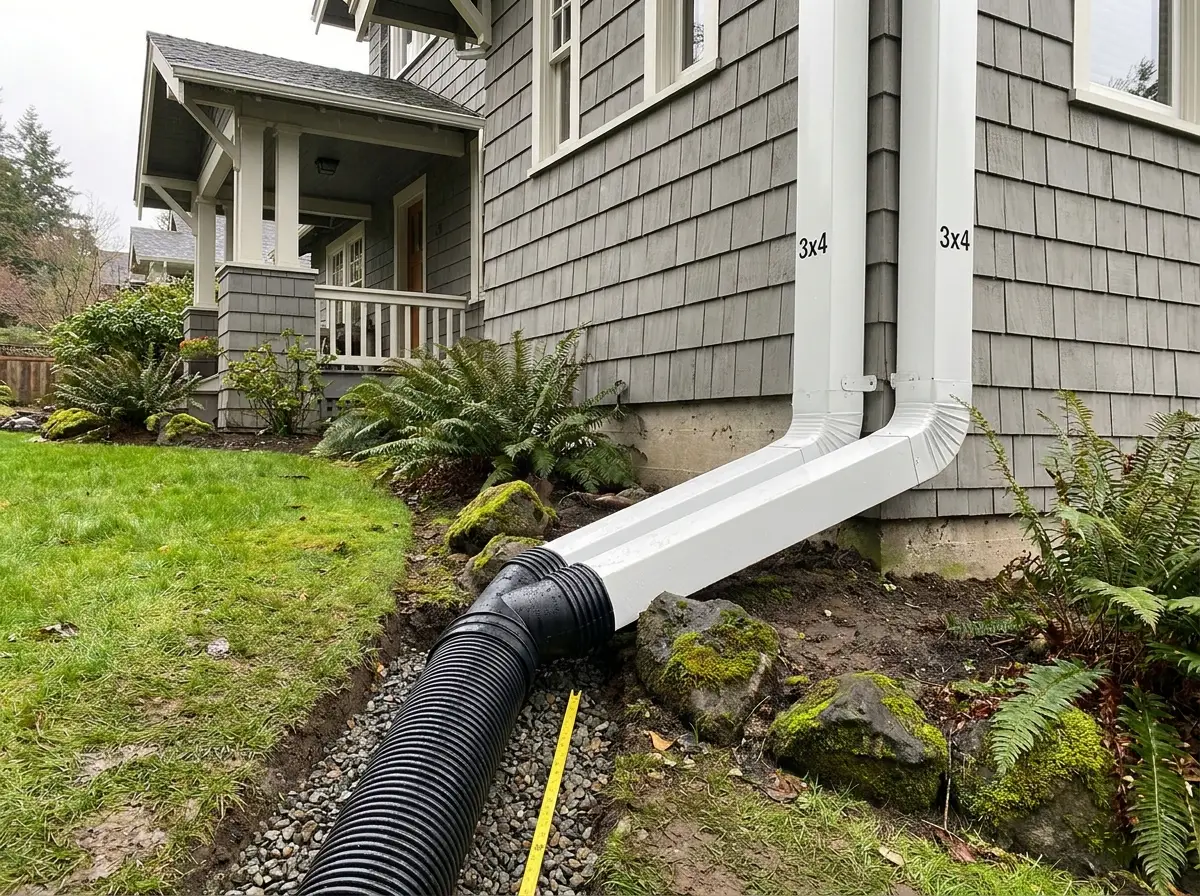
Your gutter system handles roof water. When rain falls on your roof, it flows down the shingles, into the gutters, through the downspouts, and away from the house. The purpose of gutter drainage is to collect and redirect the large volume of water that your roof surface gathers during a rainstorm. Without gutters, all of that water would cascade off the roof edge directly onto the ground next to your foundation, saturating the soil and creating conditions for basement flooding, crawl space moisture, foundation erosion, and landscape damage.
The downspout is where gutter drainage meets ground level. Where the water goes after leaving the downspout matters just as much as the gutter system itself. Common downspout discharge methods include splash blocks that direct water a few feet from the foundation, above ground extensions that carry water further out into the yard, and underground drain lines that pipe the water to a storm sewer connection, a dry well, or a discharge point at the edge of the property.
Underground drain lines connected to your downspouts are the most effective way to handle roof water in Oregon. They move the water completely away from the foundation without creating puddles, erosion, or soggy spots in your yard. Many newer Portland area homes have underground downspout connections installed during construction, but older homes often rely on splash blocks or short extensions that may not carry the water far enough.
Gutter drainage systems are designed to handle water that falls from the sky onto your roof. They are not designed to handle groundwater, which is water that moves through the soil from surrounding areas. This is where French drains come in.
What French Drains Do
A French drain is a subsurface drainage system designed to collect and redirect groundwater. It consists of a trench filled with gravel surrounding a perforated pipe. The pipe is wrapped in landscape fabric to prevent soil from clogging the perforations. Water that saturates the surrounding soil seeps through the gravel and into the pipe, which carries it away from the area by gravity to a discharge point.
French drains solve a fundamentally different problem than gutters. They address water that is already in the ground rather than water falling from the roof. In the Portland metro area, French drains are commonly installed in several situations.
Homes built on hillsides or sloped lots often need French drains on the uphill side of the house. Water flows downhill through the soil, and without a French drain to intercept it, that water hits the foundation wall and creates hydrostatic pressure that can force moisture through basement walls and floor slabs. Many homes in Southwest Portland, West Linn, and the West Hills deal with this issue because of the hilly terrain.
Properties with heavy clay soil are also common candidates for French drains. The clay soils found throughout much of the Willamette Valley drain very slowly, which means water sits near the surface and around foundations for extended periods during the rainy season. A French drain installed around the perimeter of the foundation or in the yard where water collects can dramatically reduce this problem.
French drains are also used to address surface water that pools in low spots in the yard. If you have areas where standing water persists for days after a rainstorm, a French drain can collect that water below the surface and route it to a better location. This is different from a surface drain or catch basin, which collects water from the surface through a grate rather than from the subsurface.
When You Need Both and How They Work Together
Many Oregon homes benefit from both a functional gutter system and one or more French drains. These systems address different water sources and complement each other when designed as part of a comprehensive drainage plan.
Consider a typical Portland area home on a lot with moderate slope and clay soil. The gutter system collects roof water and routes it through downspouts to underground drain lines that discharge at the lower edge of the property. Meanwhile, a French drain installed along the uphill side of the foundation intercepts groundwater flowing through the soil before it reaches the foundation wall. Both systems are working simultaneously during a heavy rain, each handling a different type of water.
One important point is that gutter downspouts and French drains should generally not connect to the same pipe. Roof water comes in large, sudden volumes during a downpour, while French drains handle a slower, steadier flow of groundwater. If you connect your downspouts to your French drain pipe, the sudden rush of roof water can overwhelm the French drain system and cause backups. Keeping the two systems separate ensures that each one functions at its best.
There are exceptions to this rule. In some situations, a single larger pipe can handle both sources, but this requires careful sizing calculations and is best done by a drainage professional who understands the specific water volumes your property deals with.
Here is a quick guide to help you determine what your property needs:
- If your problem is water overflowing from the roof, splashing against the foundation, or eroding soil near the house, you need a gutter system or improvements to your existing gutter drainage.
- If your problem is a wet basement, moisture seeping through foundation walls, or a damp crawl space even when the gutters are working properly, you likely need a French drain or interior perimeter drain.
- If your problem is standing water in the yard that persists for days after rain, a French drain or surface drain in the affected area is the solution.
- If you have multiple water problems from different sources, a combination approach is usually the most effective strategy.
The first step in solving any drainage issue is identifying where the water is coming from. Roof water and groundwater require different solutions, and misdiagnosing the source leads to spending money on the wrong fix. If you are dealing with water problems around your Portland area home and are not sure whether the issue is your gutters, your site drainage, or both, a professional assessment can sort it out quickly.
We specialize in gutter systems and downspout drainage, and we work alongside foundation and drainage contractors when a project requires French drains or other subsurface work. Give us a call for a free evaluation of your gutter system, and we can help you understand the full picture of your home's water management needs.