Your gutters can be perfectly clean and properly sloped, but if the water has nowhere to go once it exits the downspout, you still have a drainage problem. In Portland and across the metro area, poor downspout drainage is one of the leading causes of foundation damage, basement moisture, and landscape erosion. The combination of heavy seasonal rainfall and the clay rich soils found throughout the Willamette Valley makes it essential to move water away from your home quickly and effectively.
There are several proven drainage solutions that work well in Portland's climate. The right choice depends on your property's layout, soil conditions, slope, and budget.
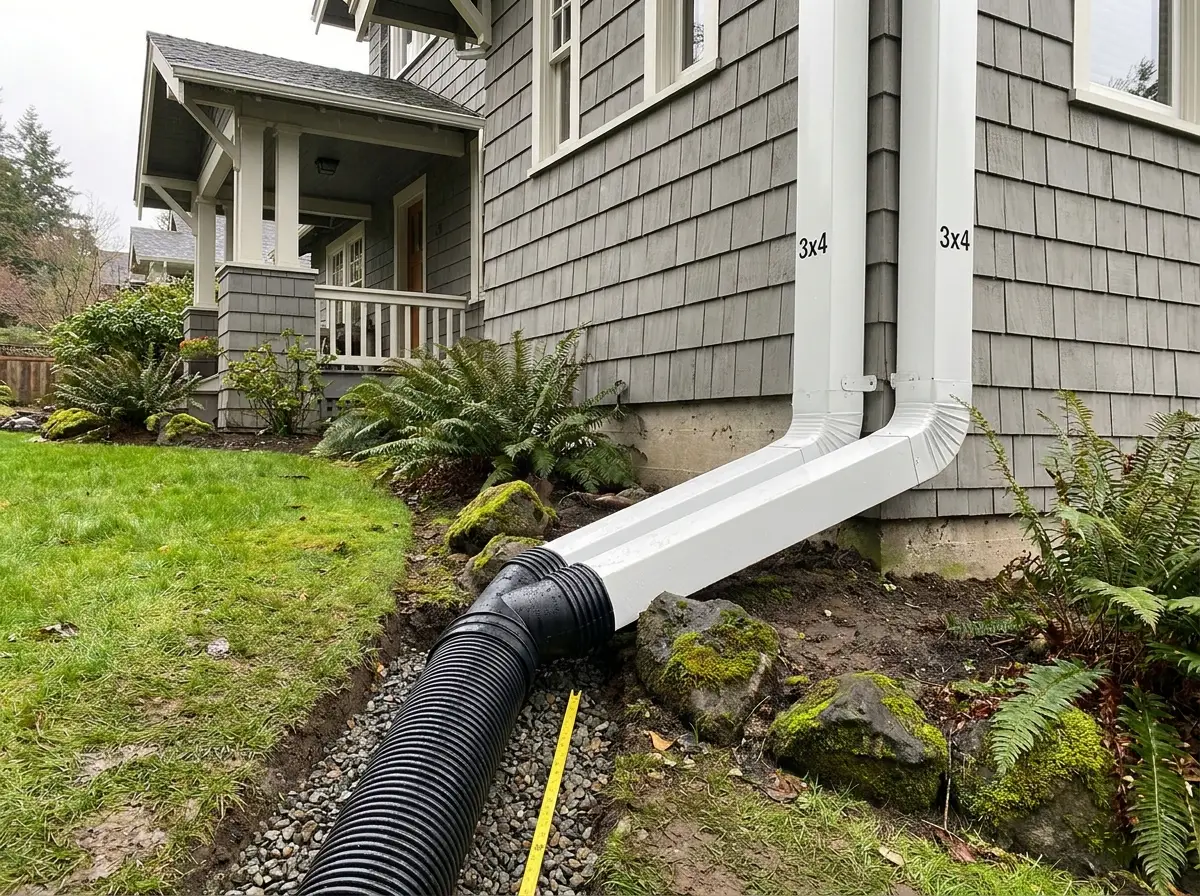
Underground Drains and Pop Up Emitters
Underground drain lines are one of the most popular and effective downspout drainage solutions for Portland homes. In this system, a buried pipe connects to the bottom of the downspout and carries water underground to a discharge point well away from the foundation. The pipe is typically 4 inch corrugated or smooth wall PVC, installed in a trench with a slight downward grade to maintain gravity flow.
Pop up emitters are a common choice for the discharge end of an underground drain. These are spring loaded caps that sit flush with the lawn surface when dry. When water pressure builds in the pipe during rainfall, the cap pops open and releases water at the surface. Once the flow stops, the cap closes again, keeping debris, dirt, and animals out of the pipe. Pop up emitters work well in Portland yards because they are nearly invisible when not in use and they handle the moderate to heavy flow rates that Oregon rainstorms produce.
The key to a successful underground drain installation in Portland is proper slope and pipe selection. The pipe needs a minimum grade of about 1 percent, meaning it drops at least one inch for every eight feet of horizontal run. In areas with clay soil, smooth wall pipe is preferable to corrugated pipe because it resists root intrusion and sediment buildup more effectively. Many older Portland homes have corrugated underground drains that have partially collapsed or filled with roots over the years, and replacing them with smooth wall PVC is one of the most impactful drainage upgrades you can make.
One important consideration for Portland homeowners is the city's stormwater regulations. Portland does not allow downspout connections to the public sewer system in most areas. Water must be discharged on your own property or directed to a designated stormwater facility. This makes on site drainage solutions not just a good idea but often a legal requirement.
Dry Wells and French Drains
A dry well is an underground chamber that collects water and allows it to slowly percolate into the surrounding soil. It consists of a perforated barrel or a pit filled with gravel, buried several feet below grade. Water from the downspout flows into the dry well through a pipe, fills the chamber, and then seeps gradually into the earth.
Dry wells are an excellent choice for Portland properties where there is no good surface discharge point. If your yard is flat, if neighboring properties are close, or if surface runoff would create problems for your neighbors, a dry well keeps all the water underground. They work best in areas where the soil has at least moderate permeability. In parts of Portland with heavily compacted clay, such as many neighborhoods in East Portland, Gresham, and Milwaukie, dry wells may need to be larger or paired with other solutions because the soil absorbs water slowly.
French drains are a related solution that handles both surface water and downspout discharge. A French drain is a trench filled with gravel and a perforated pipe, typically installed along the foundation or across a low area of the yard. Water enters the gravel, flows into the perforated pipe, and is carried to a discharge point or dry well. French drains are particularly useful on Portland properties with grading issues where water naturally flows toward the house rather than away from it.
Many homes in the West Hills, Sylvan, and the hillside neighborhoods of Southwest Portland benefit from French drains because the topography creates natural water flow patterns that direct runoff toward foundations. On sloped properties, a French drain installed along the uphill side of the home intercepts groundwater before it reaches the foundation, which is something that downspout management alone cannot accomplish.
Choosing the Right Solution for Your Property
The best drainage solution for your Portland home depends on several factors that are specific to your property. Here is a practical framework for thinking about the options:
- If your yard has good natural slope away from the house, a simple underground drain to a pop up emitter is usually sufficient and the most cost effective option. The water discharges at the low point of the yard and disperses naturally.
- If your yard is flat with limited space for surface discharge, a dry well is worth considering. It keeps water on your property without creating surface runoff that affects your neighbors or violates Portland's stormwater rules.
- If water pools near your foundation or your basement shows signs of moisture intrusion, a French drain along the foundation may be necessary in addition to downspout management. This addresses both surface water and subsurface groundwater.
- If you have an older home with downspouts that discharge directly at the foundation or connect to the sewer, upgrading to a modern underground drain system should be a priority. These outdated configurations cause preventable damage every rain season.
Soil testing can also inform your decision. Much of the Portland metro area sits on a layer of silty clay that drains poorly, especially during the wet months when the soil is already saturated. A drainage professional familiar with local soil conditions can assess how quickly your soil absorbs water and recommend solutions sized appropriately for your property.
Whatever solution you choose, proper installation matters as much as the design itself. Pipes need correct slope, connections need to be watertight, and discharge points need to be located where they will not create new problems. For Portland homeowners dealing with persistent water issues around their foundation or yard, investing in professional downspout drainage is one of the most effective ways to protect their home for the long term.